
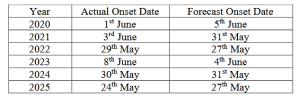
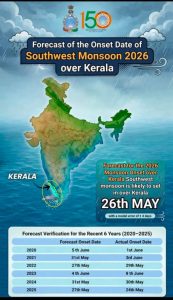
2026 Monsoon : India is likely to witness an early onset of the southwest monsoon in 2026, with the India Meteorological Department (IMD) forecasting its arrival over Kerala around May 26 — nearly six days ahead of the normal June 1 schedule. While the early onset has raised hopes among farmers and policymakers after weeks of intense summer heat, meteorologists warn that the season may still turn out weaker than normal due to emerging El Niño conditions in the Pacific Ocean.
The monsoon remains India’s most critical weather system, contributing nearly 70% of annual rainfall and supporting agriculture, drinking water supply, reservoirs, and hydropower generation. For a country where nearly half the population still depends directly or indirectly on farming, the quality and spread of rainfall are often more important than the total rainfall itself.
2026 Monsoon Early Onset Signals Positive Start
The IMD’s latest forecast suggests favorable atmospheric and oceanic conditions over the Arabian Sea and Bay of Bengal are accelerating the monsoon’s movement toward the Indian mainland. Rain-bearing winds have already advanced into the Andaman and Nicobar region earlier than usual, which is generally seen as the first stage of the southwest monsoon’s progress.
 2026 Monsoon
Meteorologists say an early onset usually benefits kharif crop sowing, especially for rice, pulses, cotton, soybean, and sugarcane farmers. States such as Karnataka, Kerala, Maharashtra, Telangana, and Andhra Pradesh could receive pre-monsoon showers earlier than expected, helping reduce the impact of prolonged heatwave conditions seen in April and early May.
However, weather experts caution that an early onset does not necessarily guarantee a strong or evenly distributed monsoon season. Several years in the past decade have shown that monsoon progression and total rainfall can differ sharply after an early start.
Monsoon 2026 Could Be a Below-Normal Monsoon Year
Despite the optimistic beginning, the IMD’s long-range forecast predicts that India may receive below-normal monsoon rainfall this year, estimated at around 90–95% of the Long Period Average (LPA).
The main reason behind the concern is the rapid development of El Niño conditions in the Pacific Ocean. El Niño refers to abnormal warming of ocean waters in the central and eastern Pacific, which weakens the Indian monsoon circulation. Historically, El Niño years have often been associated with droughts or deficient rainfall in India.
International climate agencies and weather experts now believe El Niño may strengthen earlier than initially expected and continue through much of the monsoon season.
If that happens, rainfall during the second half of the monsoon — especially August and September — could weaken considerably. Skymet Weather has already projected a strong deficit signal for September rainfall, raising concerns about moisture stress during critical crop growth periods.
2026 Monsoon Lessons From the Last Ten Years
The last decade has shown how unpredictable the Indian monsoon has become due to climate change and ocean warming.
In 2015 and 2016, strong El Niño conditions contributed to severe rainfall deficits across several states, leading to drought-like situations in Maharashtra, Karnataka, and parts of central India. Reservoir levels fell sharply, agricultural output suffered, and rural distress increased.
Between 2019 and 2023, however, India experienced multiple years of above-normal or excess rainfall. Those years brought widespread floods, urban water logging, and crop damage in many states. Kerala, Assam, Himachal Pradesh, Uttarakhand, and Karnataka repeatedly experienced extreme rainfall events.
Experts say the monsoon has become increasingly erratic rather than simply weak or strong. Instead of steady seasonal rainfall spread across four months, India is now seeing long dry spells interrupted by extremely heavy rain events over short periods.
Research studies also suggest that climate change is altering monsoon patterns, increasing rainfall variability and extending rainy periods in some regions of southern India.
2026 Monsoon Southern India May Fare Better
While many regions may face deficient rainfall risks, forecasts indicate that parts of southern peninsular India and northeast India could still receive near-normal or above-normal rainfall.
This could benefit states such as Karnataka, Tamil Nadu, Kerala, and Andhra Pradesh, especially during the early phase of the season. However, uneven rainfall distribution may continue to remain a challenge.
Meteorologists note that Karnataka may initially receive good pre-monsoon and early monsoon showers, but rainfall consistency through July and August will depend heavily on the strength of monsoon currents and Bay of Bengal systems.
2026 Monsoon Agriculture and Economy at Stake
A weaker monsoon can have widespread consequences for India’s economy. Agriculture contributes significantly to rural employment and food supply. Poor rainfall can reduce production of rice, pulses, soybean, cotton, and sugarcane, eventually pushing food prices higher.
Economists are also watching the monsoon closely because food inflation remains one of the biggest concerns for policymakers. Weak rainfall could increase prices of vegetables, cereals, edible oils, and dairy products.
Hydro power generation may also be affected if reservoirs fail to fill adequately during the season. Several states already entered summer with lower-than-average water storage levels after an unusually hot premonition period.
At the same time, excessive short-duration rainfall events can create another set of problems — flash floods, landslides, crop damage, and urban flooding. Cities like Bengaluru, Mumbai, Chennai, Hyderabad, and Delhi have repeatedly struggled with drainage failures during heavy monsoon spells over the last decade.
Better Forecasting Technology This Year
One important development in 2026 is the launch of new AI-enabled forecasting systems by the IMD. These advanced models are designed to improve localized rainfall prediction and provide village-level weather forecasts weeks in advance.
Experts believe improved forecasting could help farmers plan sowing schedules more effectively and assist governments in disaster management preparations.
The IMD is also expected to issue updated forecasts in June and July as monsoon patterns become clearer.
What Happens Next?
The next few weeks will be crucial in determining the overall quality of the 2026 monsoon season. If the monsoon advances rapidly after reaching Kerala and maintains strong rainfall activity through June and July, concerns about rainfall deficits could reduce.
However, if El Niño intensifies by mid-season, India could face weaker rainfall during the critical second half of the monsoon.
For now, the outlook reflects a mixed picture: an encouragingly early start, but uncertainty about the season’s long-term strength. Farmers may welcome the first showers, but weather experts continue to advise caution.
After a decade marked by climate extremes — droughts, floods, heatwaves, and erratic rainfall — the 2026 monsoon once again highlights how deeply India’s future remains tied to the rhythm of the rains.